Ranking #1 no longer guarantees visibility, attention, or meaningful engagement. In 2026, search results are dominated by AI summaries, answer boxes, maps, and media elements that appear before traditional listings. As a result, a page can technically rank first and still go largely unseen.
This shift explains why many sites see declining results even when rankings look strong. The issue isn’t performance. It’s where visibility now happens.
Search Visibility Explained at a Glance
Why isn’t ranking #1 enough anymore?
Because users often interact with AI summaries, direct answers, and rich features before they ever reach organic listings.
What replaced the old ranking model?
Search results now prioritize answers, citations, and multi-format presence across the page instead of a single blue link.
What should SEO measure instead of rankings?
Visibility across AI summaries, featured answers, discovery features, and brand placements.
Does this mean SEO no longer matters?
No. It means SEO now rewards authority and clarity rather than position alone.
This shift only makes sense once you understand how modern search systems interpret meaning instead of keywords. If you haven’t read it yet, start with How Semantic SEO Works in 2026 and Why Keywords Alone No Longer Rank.
Why Ranking #1 Can Still Lose Visibility
Ranking first no longer guarantees attention because users experience search pages very differently than they did in the past.
A client example makes this clear. They ranked #1 for a high-volume keyword that historically drove consistent leads. Despite holding that position, organic results dropped by more than 40 percent over six months.
Nothing broke. The page didn’t fall.
The visibility shifted elsewhere.
Their listing was still technically “first,” but it appeared beneath AI summaries, related questions, maps, and videos. By the time users reached it, decisions had already been made.
What Replaced the Ten Blue Links Model
The traditional search layout no longer exists for most queries.
Before a user reaches a standard organic result, they often encounter:
- AI-generated summaries that occupy the top of the page
- Expandable question sections answering follow-ups instantly
- Local results or maps for any location-based intent
- Video and image carousels that capture attention first
Article published by Ahrefs shows that an increasing share of searches now end without clicks as Google surfaces answers, SERP features, and rich results ahead of organic listings.
In many cases, the first organic listing appears only after users have already found what they needed.
Why Zero-Click Searches Are Now Normal
A majority of searches now end without a click because search engines increasingly surface answers directly on the results page.
This doesn’t mean content isn’t being used. It means content is being extracted and displayed elsewhere.
According to guidance from Google Search Central, features like featured snippets, rich results, and AI-powered summaries are designed to help users complete tasks without visiting multiple websites.
Your page may:
- Power a featured snippet
- Be summarized in an AI Overview
- Be cited as a source without earning a visit
Visibility still exists. It just happens before the click.
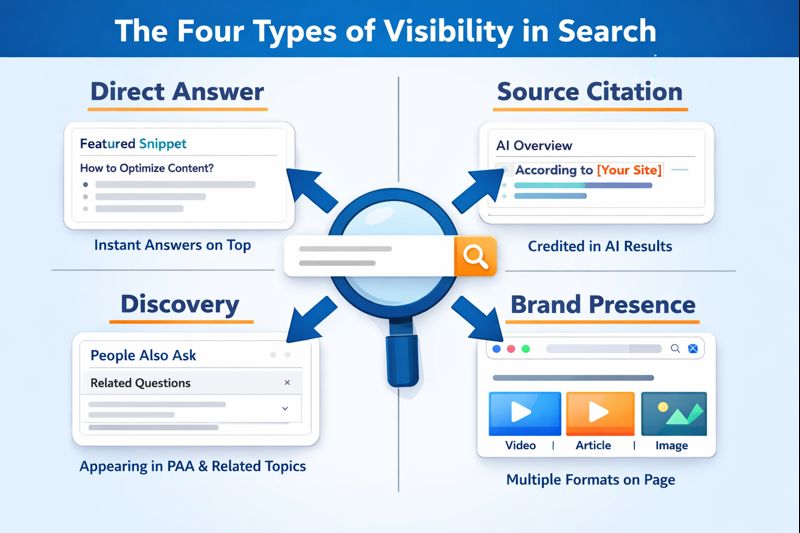
The Four Types of Visibility That Matter Now
Search performance is no longer one-dimensional. Visibility now comes in multiple forms, each influencing decisions differently.
Direct Answer Visibility
Direct answers appear as featured snippets or how-to boxes. When your content is selected, you become the reference point for that question, even if the user never visits your site.
This builds recognition and trust at the moment of need.
Source Citation Visibility
Source citations appear when your content is referenced inside an AI-generated summary. This acts as a credibility signal, similar to how authoritative links once functioned.
Being cited signals reliability, even without direct engagement.
Discovery Visibility
Discovery visibility occurs when your content appears in related questions or exploratory sections. This captures users who are still learning and comparing options.
It’s where influence begins before intent is finalized.
Brand Presence Visibility
Brand presence comes from appearing multiple times on the same page through text, video, images, or answers. Repeated exposure builds familiarity far more effectively than a single ranking.
Being seen more than once changes perception.
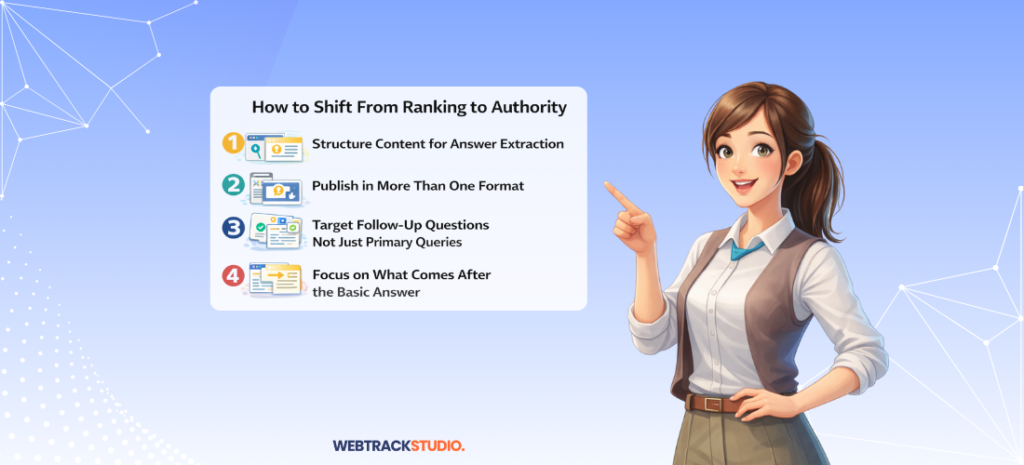
How to Shift From Ranking to Authority
Winning in modern search requires optimizing for extraction and presence, not just clicks.
Step 1: Structure Content for Answer Extraction
Content should be written so individual sections can stand on their own.
Use clear, question-based headings. Follow each with a concise answer before expanding. Lists, tables, and structured sections make it easier for search systems to surface your content where users are already looking.
Step 2: Publish in More Than One Format
Each format creates another opportunity to appear.
A single article gives you one entry point. An article supported by a short video or visual asset gives you multiple chances to be visible across the same results page.
Step 3: Target Follow-Up Questions, Not Just Primary Queries
Search rarely ends with one question.
Answering related questions within the same piece increases the chance of appearing multiple times across a single page. One article can earn several visibility placements when structured intentionally.
Step 4: Focus on What Comes After the Basic Answer
AI summaries handle definitions well. Your content should handle application, nuance, and decision-making.
If the AI explains what something is, your page should explain how to use it, apply it, or choose between options.
What This Means for Anyone Publishing Content
Search success is no longer about being first. It’s about being present wherever decisions are formed.
Teams should stop asking:
- “What position are we ranking in?”
And start asking:
- “Where are we visible on the page?”
- “Are we being cited or referenced?”
- “Do users encounter us more than once before deciding?”
Visibility is no longer a single metric. It’s a system.
Frequently Asked Questions About Search Visibility
Is ranking still important at all?
Yes, but rankings are now a baseline. Visibility determines impact.
Can brands benefit without direct clicks?
Yes. Citations, answers, and repeated exposure influence decisions before visits occur.
Should content be written differently now?
Yes. Content should be structured for clarity, extraction, and reuse across formats.
Is this shift only relevant for large brands?
No. Smaller teams often win by being clearer, more focused, and more helpful.
The Bottom Line
In modern search, the winner is not the brand at the top of a list. The winner is the brand that shows up everywhere attention flows.
Ranking first is a surface signal. Being visible is the advantage.
What’s Next
Part 3 will explain how search systems evaluate topical authority across an entire site, not just individual pages.
If rankings look stable but results feel weaker, it’s time to audit visibility instead of positions.
Request a search visibility review
We’ll show you where your content appears, where it’s extracted, and where it disappears before users ever see it.