SEO rarely fails all at once. It doesn’t collapse overnight unless something reckless happens. Instead, SEO fades.
It begins with a plateau. You’re publishing consistently, but growth stalls. Then new pages take weeks to index. Finally, your most reliable posts, the ones that drove revenue for years, start slipping without a clear cause.
In 2026, many brands are hitting a visibility ceiling. They’re doing the work, but the engine has stalled.
Here’s why SEO stops working and what breaks beneath the surface.
SEO Failure Explained at a Glance
Why does SEO stop working even when nothing is “wrong”?
SEO stops working when core systems that support visibility degrade over time.
Does SEO fail suddenly?
No. It usually declines through plateaus, indexing delays, and gradual ranking erosion.
What breaks first when SEO stalls?
Information gain, topical authority, intent alignment, technical efficiency, trust, and human engagement.
Can SEO recover after it stops working?
Yes, but only by fixing what broke instead of publishing more content.
Where SEO Breaks
SEO doesn’t stop working because of one mistake. It stops working when key systems quietly fail.
In practice, SEO breaks in six places:
Information Gain breaks when your content adds nothing new to what already exists.
Topical Authority breaks when your site covers topics inconsistently instead of owning a subject area.
Technical Efficiency breaks when crawl budget is wasted on low-value or outdated pages.
Intent Alignment breaks when search behavior changes but content stays the same.
Trust breaks when authorship, credibility, or real-world proof is missing.
Human Engagement breaks when content is written for algorithms instead of people.
When one system fails, performance weakens. When several fail together, SEO appears to “stop working.”
This breakdown builds on how modern search systems interpret meaning and authority. If you haven’t read it yet, start with How Semantic SEO Works in 2026 and Why Keywords Alone No Longer Rank.
We also covered how rankings can hold steady while visibility disappears in why ranking #1 no longer delivers visibility, which explains why many SEO failures feel sudden.
Why SEO Rarely Fails All at Once
SEO erosion is gradual.
Search systems reduce confidence slowly as signals weaken. That’s why early warning signs often feel disconnected until traffic loss becomes impossible to ignore.
Information Gain Breaks
SEO breaks first when content becomes a mirror.
For years, the dominant strategy was to take what ranked and make it longer. In an AI-driven search environment, this produces interchangeable content.
If your page says what ten others already say, there’s no reason to surface it.
The symptom
Technically sound pages that never break past page two or three.
The fix
Introduce value that cannot be summarized or scraped:
- Original data
- First-hand experience
- Contrarian or corrective insight
Without information gain, SEO plateaus by design.
Topical Authority Breaks
SEO fails when content loses focus.
Publishing isolated hits across unrelated topics signals breadth, not expertise. Search systems reward ownership, not experimentation.
The symptom
You rank for scattered terms but can’t hold positions tied to revenue.
The fix
Commit to topic clusters. High-value terms require supporting depth. Authority comes from consistency, not variety.
Technical Efficiency Breaks
Sometimes content is strong, but the system carrying it isn’t.
Search engines are selective about where they spend crawl resources. Bloated archives, thin legacy posts, and duplicate structures reduce efficiency.
Google explains that its systems prioritize useful pages and efficient crawling. When technical debt accumulates, new content struggles to earn attention.
The symptom
Pages remain “Discovered – currently not indexed” for weeks.
The fix
Prune aggressively:
- Remove low-value content
- Merge overlapping posts
- No-index utility pages
SEO doesn’t fail because of one technical issue. It fails when inefficiency compounds.
Intent Alignment Breaks
Search intent is not permanent.
A keyword that once implied buying intent may shift toward education or comparison. When content doesn’t evolve, visibility declines.
Independent research shows that fewer than half of searches now result in a click, reinforcing how intent shifts affect performance before rankings collapse.
The symptom
Stable rankings but falling CTR and rapid exits.
The fix
Audit SERPs regularly:
- If results are videos, publish video
- If results are tools, build tools
- If results are lists, restructure content
SEO breaks when content answers the wrong question.
Trust Breaks
In saturated search environments, trust is the differentiator.
Weak authorship, missing credentials, and lack of proof quietly reduce confidence over time.
The symptom
A core update hits and traffic drops despite no visible mistakes.
The fix
Strengthen trust signals:
- Clear author bios
- Real credentials
- Screenshots, examples, and proof
Trust loss is silent. Recovery is not.
Human Engagement Breaks
SEO can fail because it feels optimized.
When content reads like it was written for algorithms, users disengage. When users disengage, search systems notice.
The symptom
Pages rank, but no one remembers the brand.
The fix
Write for a skeptical human. Cut filler. Say fewer things, but say something real.
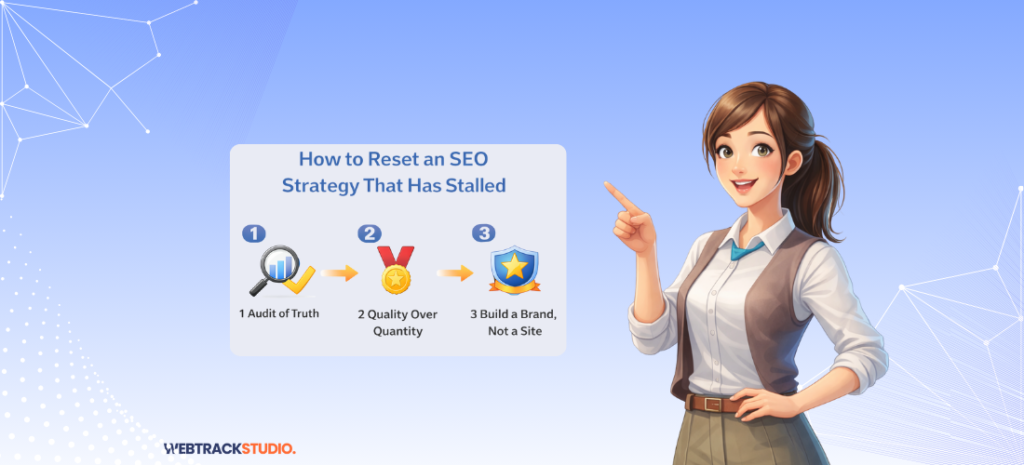
How to Reset an SEO Strategy That Has Stalled
When SEO stops working, doing more of the same accelerates failure.
Step 1: The Audit of Truth
Review performance by URL, not keyword. Patterns reveal what broke.
Step 2: Quality Over Quantity
Pause publishing. Strengthen what already matters. One strong page outperforms fifty average ones.
Step 3: Build a Brand, Not a Site
Search systems reward entities. Brands are entities. Sites are not.re not just navigation. They act as contextual signals that show how knowledge is organized across your site.
What This Means for Anyone Relying on SEO
SEO doesn’t stop working because search is broken.
It stops working because expectations lag behind reality.
Ranking is no longer the goal. Authority is.h level. Support it with focused articles that explore individual subtopics in depth, and link them intentionally. This structure mirrors how humans learn and how AI understands.
Frequently Asked Questions About SEO Failure
Why does SEO stop working even when rankings don’t drop?
SEO can stop working when visibility shifts away from traditional listings toward answers, summaries, and other search features. Rankings may hold while attention disappears.
Can SEO recover after it stops working?
Yes, but recovery requires fixing the underlying breakpoints like information gain, intent alignment, and trust rather than publishing more content.
How long does it take to fix a stalled SEO strategy?
It depends on what broke. Intent and content issues can improve within weeks, while authority and trust rebuild over months through consistent signals.
Is technical SEO usually the main reason SEO fails?
Not usually. Technical issues often accelerate failure, but SEO typically breaks first at the content, intent, or authority level.
Does publishing more content help when SEO stalls?
No. Publishing more low-impact content often makes the problem worse by increasing technical debt and diluting authority.
What is the earliest sign that SEO is breaking?
Plateaued growth combined with slower indexing and declining engagement is usually the first warning sign.
The Bottom Line
SEO isn’t dead. It’s disciplined.
The shortcuts that worked years ago now create fragility. Sustainable visibility comes from clarity, trust, and originality.
Stop trying to rank.
Start trying to be worth surfacing.
What’s Next
Part 4 shows how technical trust affects crawling, indexing, and rankings, and why good content often stalls when the technical foundation is weak.
If your SEO feels stalled but you can’t pinpoint why, don’t publish more content yet.
Start with a visibility and breakage audit.
We’ll identify:
- which system broke first
- where authority or intent slipped
- and what to fix before doing anything else
Request a semantic SEO reset review and get clarity before making another move.