How Search, Visibility, Performance, and Accessibility Actually Work
In 2026, most sites don’t lose visibility because they did something “wrong.” They lose it because they no longer meet the expectations of modern search systems.
Search engines don’t just rank pages. They decide what to crawl, what to index, what to surface, and what to trust.
This guide explains how that system works today — and where it quietly breaks.
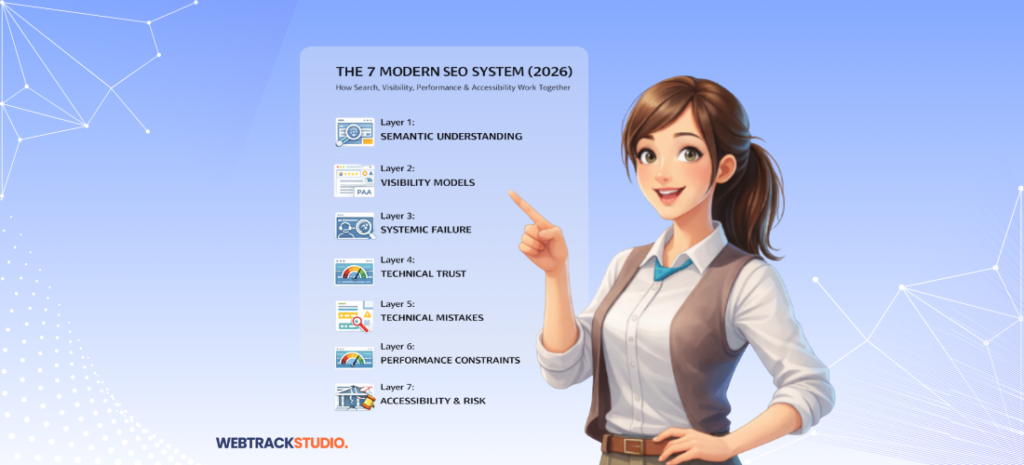
SEO Explained at a Glance
What changed?
Search systems now evaluate meaning, reliability, usability, and risk before rankings matter.
Why does this matter?
Because visibility is no longer guaranteed by rankings alone.
What fails first?
Understanding, trust, crawl confidence, performance, and accessibility — long before traffic collapses.
What replaces traditional SEO?
A layered system where content, structure, experience, and risk control determine eligibility.
The 7 Layers of Modern SEO (2026 Model)
SEO in 2026 works as a stack, not a checklist. Each layer depends on the one below it. When a lower layer fails, everything above it weakens. Even if rankings look stable.
Layer 1: Semantic Understanding
Why Keywords Alone No Longer Rank
Search systems no longer evaluate pages by phrase matching. They evaluate topic understanding. Pages succeed when they:
- Cover concepts, not keywords
- Address intent, not volume
- Connect related ideas clearly
Pages fail when they look optimized but lack understanding.
👉 Deep dive: How Semantic SEO Works in 2026 and Why Keywords Alone No Longer Rank
Layer 2: Visibility Models
Why Ranking #1 Is No Longer Enough
Ranking first no longer guarantees attention. Modern SERPs are dominated by:
- AI Overviews
- Direct answers
- People Also Ask
- Local packs
- Visual results
Visibility happens before the click. If your content isn’t eligible for extraction, citation, or discovery, ranking position becomes irrelevant.
👉 Deep dive: Why Ranking #1 No Longer Delivers Visibility and How Search Works Now
Layer 3: Systemic Failure
When SEO Stops Working
SEO rarely fails overnight. It fades when:
- Information gain disappears
- Topical authority weakens
- Intent shifts
- Trust erodes
- Human engagement drops
These failures don’t trigger penalties. They quietly reduce eligibility.
👉 Deep dive: When SEO Stops Working and What Breaks
Layer 4: Technical Trust
Why Crawling and Indexing Are Gated
Search systems are resource-constrained. Before evaluating content, they assess whether a site is:
- Efficient to crawl
- Predictable to render
- Worth indexing
If technical trust weakens, exposure is throttled silently.
👉 Deep dive: Why Technical Trust Controls Indexing, Crawling, and Rankings
Layer 5: Technical Mistakes
How Teams Quietly Kill Visibility
Most technical SEO failures are self-inflicted. Visibility drops when teams:
- Bury important pages
- Inflate the index with low-value URLs
- Rely on heavy client-side rendering
- Break internal linking logic
- Strip mobile parity
These aren’t algorithm updates. They’re operator errors.
👉 Deep dive: Technical SEO Mistakes That Quietly Kill Visibility
Layer 6: Performance Constraints
Why Speed Is a Revenue Issue
Slow sites don’t just rank worse. They convert worse. Performance impacts:
- Bounce rates
- Lead quality
- Engagement depth
- Revenue efficiency
By the time rankings decline, revenue damage is already done.
👉 Deep dive: Why Slow Websites Kill Conversions Not Just Rankings
Layer 7: Accessibility & Risk
Why Ignoring Accessibility Creates SEO and Legal Risk
Accessibility is no longer optional infrastructure. Inaccessible sites:
- Are harder to use
- Are harder to interpret
- Create legal exposure
- Scale poorly
Accessible sites are clearer, safer, and easier for both users and systems to trust.
👉 Deep dive: Why Ignoring Accessibility Creates SEO and Legal Risk
How These Layers Work Together
This is not a linear checklist. It’s a dependency chain:
- No semantic clarity → nothing to evaluate
- No visibility eligibility → rankings don’t matter
- No trust → crawling slows
- No technical reliability → indexing fragments
- No performance → conversions collapse
- No accessibility → risk compounds
Most SEO problems aren’t isolated. They’re stack failures.
What This Means for Teams
If growth feels capped despite effort, the issue is rarely “more SEO.” It’s usually:
- A lower layer breaking silently
- A system assumption that no longer holds
- A constraint introduced earlier than expected
Fixing the wrong layer wastes time. Fixing the right one unlocks everything above it.
Frequently Asked Questions
Is SEO still worth investing in?
Yes but only if treated as a system, not a tactic.
Why does traffic drop without penalties?
Because eligibility weakens before enforcement occurs.
Can great content overcome technical issues?
No. Content is evaluated only after trust, performance, and accessibility are established.
Is this model only for large sites?
No. Smaller sites feel these failures sooner because margins are thinner.
The Bottom Line
SEO in 2026 is no longer about ranking pages.
It’s about:
- Being understandable
- Being reliable
- Being efficient
- Being usable
- Being safe to scale
When those conditions are met, visibility follows. When they aren’t, no tactic compensates.
Request a Full SEO System Audit
This audit identifies which layer is limiting visibility, conversion, or growth and where fixing the system unlocks results.