Accessibility is no longer optional in modern websites.
In 2026, inaccessible sites don’t just exclude users. They introduce friction that affects usability, semantic clarity, assistive interpretation, and legal exposure. These issues rarely trigger immediate penalties. Instead, they accumulate quietly.
Over time, sites become harder to understand, harder to crawl, and harder to scale safely.
This article explains why ignoring accessibility creates long-term SEO and legal risk, how those risks surface before rankings collapse, and why accessible sites are easier for both users and systems to trust.
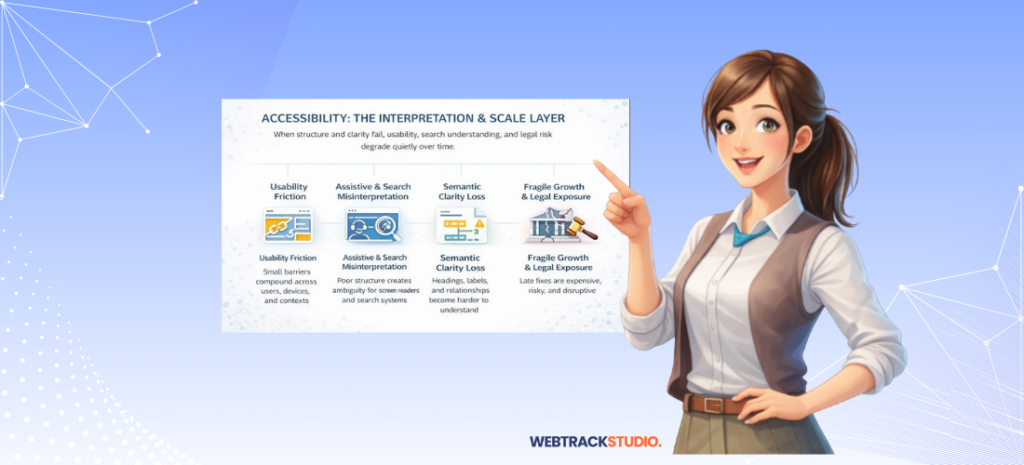
Accessibility Explained at a Glance
What is happening?
Sites that are difficult to navigate, interpret, or interact with lose trust from users, assistive technologies, and search systems.
Why is it happening?
Modern evaluation systems rely on predictable structure, clear semantics, and perceivable interfaces.
What fails first?
Usability, semantic clarity, and assistive interpretation weaken before rankings visibly decline.
This final article builds on the earlier parts of the series. After technical trust, technical mistakes, and performance constraints, accessibility becomes the risk and scale layer that determines whether growth is stable or fragile.
Why Inaccessible Sites Are Difficult to Use
Accessibility is usability under real-world constraints. Designs that work only for ideal users fail when conditions change: smaller screens, slower devices, alternative input methods, or cognitive load.
What’s really happening
Inaccessible interfaces introduce friction for everyone, not just edge cases.
Common signs
- Confusing navigation flows
- Interactive elements without clear focus states
- Content that relies on visual cues alone
Why teams cause this
Accessibility is treated as compliance, not experience design.
What to fix
Design for clarity first. Clear labels, predictable navigation, and visible feedback improve usability across all users.
Why Ignoring Accessibility Creates Legal Risk
Accessibility is no longer optional from a compliance standpoint.
Regulatory expectations continue to expand, and enforcement increasingly targets digital properties. Sites that ignore accessibility create exposure that compounds as they scale.
What’s really happening
Risk accumulates quietly until it surfaces through audits, complaints, or legal action.
Why this matters for growth
Fixing accessibility late is expensive and disruptive. Fixing it early is structural.
What to fix
Treat accessibility as a default standard. Build it into design systems, templates, and QA workflows instead of retrofitting it later.
Why Search Systems Struggle to Understand Inaccessible Sites
Accessible content is explicit content.
Clear headings, meaningful labels, proper landmarks, and descriptive links reduce ambiguity. They make intent obvious.
What’s really happening
Accessibility enforces clarity. Clarity improves interpretation.
Why this matters for SEO
Search systems rely on the same signals as assistive technologies: structure, relationships, and meaning. When content is accessible, it is easier to parse, categorize, and evaluate.
Why Screen Readers and Search Systems Fail on Poor Markup
Assistive technologies don’t guess. They rely on structure.
When markup is inconsistent or incomplete, interpretation breaks—not just for users, but for systems that depend on similar signals.
What’s really happening
Assistive interpretation failures mirror search interpretation failures.
Why teams miss this
Testing is done visually, not programmatically.
What to fix
Ensure content is navigable and understandable without sight, mouse input, or assumptions about interaction.
Why Accessible Sites Are Easier to Crawl and Scale Safely
Accessibility creates predictable patterns. Predictable patterns reduce processing cost.
Sites with clear structure, consistent navigation, and explicit relationships are cheaper to crawl, easier to index, and safer to expand.
What’s really happening
Accessibility reduces friction at every layer: user, system, and scale.
This is why accessible sites tend to age better.
What Happens When Accessibility Is Ignored Long Term
Ignoring accessibility doesn’t cause an immediate ranking drop.
It causes:
- Compounding usability debt
- Increased legal exposure
- Semantic ambiguity
- Fragile scaling
By the time these issues surface, remediation is expensive and disruptive.
Frequently Asked Questions About Accessibility and SEO
Is accessibility a direct ranking factor?
Not as a single metric. Accessibility influences multiple systems that affect evaluation, trust, and usability.
Does accessibility only matter for certain industries?
No. Any site that wants to scale safely benefits from accessible design.
Can accessibility improvements help SEO indirectly?
Yes. Clear structure, labels, and navigation improve interpretation for both users and search systems.
Is accessibility only a front-end concern?
No. It affects content structure, interaction logic, and system design decisions.
The Bottom Line
Accessibility is not a preference or a compliance checkbox.
Inaccessible sites are harder to use, harder to interpret, and riskier to scale. Over time, that friction compounds into usability debt, semantic ambiguity, and legal exposure.
Accessible sites behave differently. They are clearer, more predictable, and easier for users and systems to trust.
In modern search and product environments, accessibility is not optional infrastructure. It is part of how long-term visibility and stability are maintained.
Request an Accessibility & Risk Review
This review identifies usability barriers, semantic gaps, and accessibility risks that limit growth and increase exposure before they become costly to fix.