AI Overview
Googlebot indexes only the first 2MB of uncompressed HTML on a web page, so content that appears late in the source code may not be fully considered for indexing. As modern websites rely more on heavy templates, scripts, and component-based layouts, important headings, context, and internal links are often pushed down, reducing search visibility. Improving content order and early HTML clarity can have a greater impact on SEO performance than publishing additional content.
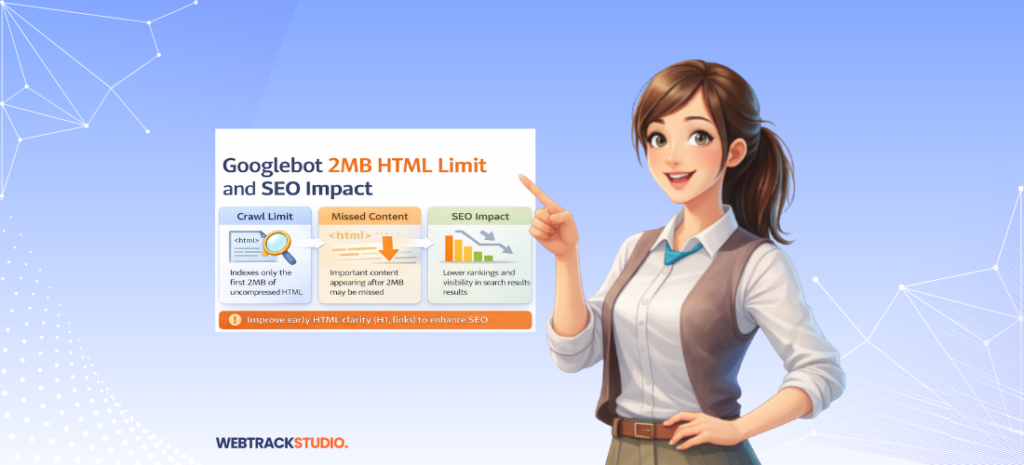
Googlebot’s 2MB HTML Limit Explained at a Glance
What is happening
Googlebot indexes only the first 2MB of uncompressed HTML for standard web pages and 64MB for PDF files. Anything beyond that point is not used for indexing.
Why it’s happening
Google relies on early-loaded HTML to understand what a page is about before rendering everything else.
What changed
Google clarified this behavior in its crawler documentation on February 3, making the limits and their impact explicit.
Google’s Latest Crawling Update
Google did not introduce a new crawling rule. It clarified how much content Googlebot actually processes when crawling a page.
According to Google Search Central, once Googlebot reaches the 2MB uncompressed HTML limit, it stops fetching and indexes only the content already downloaded.
Source: Google Search Central
https://developers.google.com/crawling/docs/crawlers-fetchers/overview-google-crawlers#file-size-limits
This matters because many modern websites reach this limit faster than expected due to heavy templates, scripts, and injected components.
How This Affects Your Pages
This affects pages where important content appears late in the HTML source.
Google forms its first understanding of a page from what it sees early. If navigation, scripts, or layout wrappers dominate the top of the source code, Google may crawl the page but struggle to clearly understand its intent.
That leads to pages that:
- Look fine to users
- Have decent content
- But underperform in search
This is not a quality issue. It’s a discovery issue.
Which Sites Are Most Affected
This clarification matters most for sites where templates outweigh content.
E-commerce sites
Large category pages, filters, personalization layers, and injected scripts often delay core content.
SaaS websites
Marketing pages built from reusable components and frameworks commonly push intent signals down.
Media and publishing sites
Long articles with embeds, ads, and widgets reach the limit faster than expected.
Enterprise sites
Global templates with tracking and personalization layers add HTML weight quickly.
Smaller, simpler sites are usually less affected.
Impact on On-Page SEO
On-page SEO is affected when intent signals are delayed.
If the H1, opening context, and internal links appear far down the HTML, Google may still index the page but align it with weaker or broader queries.
Common signs include:
- Rankings that stall without obvious errors
- Pages ranking for the wrong terms
- Missed opportunities in featured snippets or AI Overviews
This is especially common on sites using page builders or component-based layouts.
Impact on Technical SEO
From a technical perspective, crawl efficiency drops when templates are heavy.
Large DOM structures, inline scripts, and multiple wrappers consume crawl resources before Google reaches meaningful content.
Even though Google can render JavaScript later, early discovery still influences how much importance the page receives.
Google has been clear that crawling and rendering are separate processes with different limits.
Source: Google Search Central
https://developers.google.com/search/docs/crawling-indexing/javascript/javascript-seo-basics
What SEOs Should Check First
Move key content earlier
Place the H1, opening copy, internal links, and important schema high in the HTML source, even if the visual layout stays the same.
Review template weight
If a script or widget does not support UX or revenue, it should be questioned.
Simplify markup
Deep nesting and excessive wrappers slow discovery.
Review hidden content carefully
Tabs and accordions are fine for users, but risky if content is rendered late or conditionally.
Test like a crawler
Use View Source and compare raw HTML with rendered output to see what Google encounters first.
For background context, see:
How Google Crawls and Indexes Pages
For next steps, see:
How Content Should Be Structured for AI Overviews
Frequently Asked Questions
Does Google ignore content after 2MB?
Google stops fetching after 2MB of uncompressed HTML and indexes only what it has already downloaded.
Do pages need to be shorter?
No. The goal is earlier clarity, not less content.
Does this affect JavaScript-heavy sites?
Yes. Late-rendered content may have less influence on relevance.
Is this urgent?
It’s an audit priority, not an emergency rebuild.
Does this affect AI visibility?
Yes. AI systems rely on early, clear signals just like search.
Next Step
Before publishing more content, check whether your most important signals appear early in the HTML.
If your H1, intro copy, and internal links load late, improving structure will often have more impact than adding new pages.
A short HTML and template review can reveal issues that dashboards never show.
Feel free to connect if you’d like a second look at how Googlebot reads your pages and where content priority may be holding you back.